
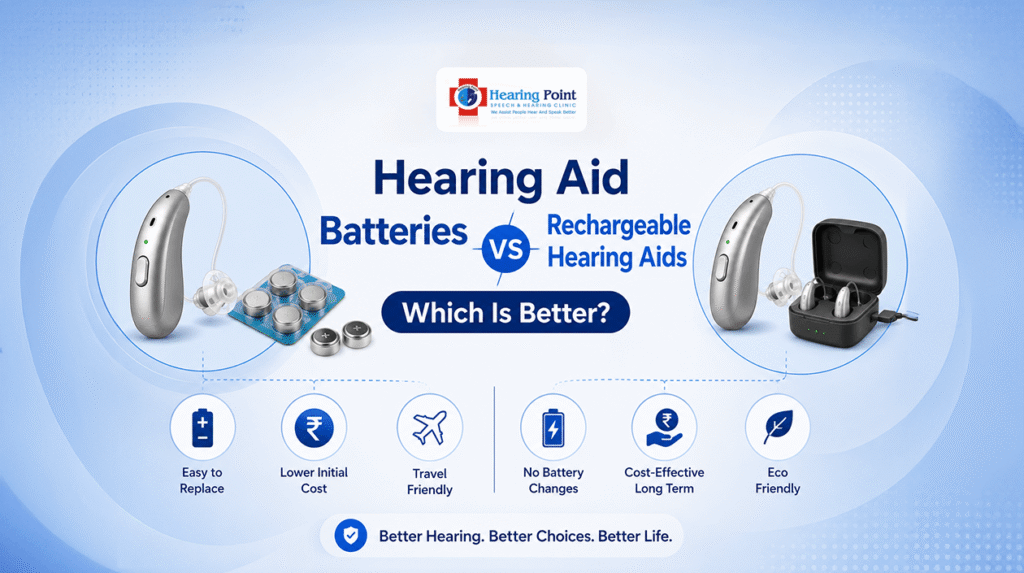
Rechargeable hearing aids and battery-powered hearing aids each have advantages depending on your lifestyle, dexterity, daily routine, and hearing needs. Rechargeable models offer convenience and reduced maintenance, while battery-powered hearing aids provide flexibility and easy battery replacement. Understanding the differences can help you choose the option that best fits your everyday life.
| Quick Facts | |
| Best For | First-time hearing aid buyers comparing power options |
| Reading Time | 10–12 minutes |
| Main Question | Should I choose rechargeable or battery-powered hearing aids? |
| Short Answer | Rechargeable hearing aids are ideal for most users seeking convenience, while battery-powered models remain a practical choice for certain lifestyles and travel needs. |
| Key Topics | Battery life, charging, maintenance, costs, travel, reliability and lifestyle considerations |
About This Guide
One of the most common questions people ask when choosing hearing aids is whether rechargeable models are better than traditional battery-powered devices.
This guide compares both options in a simple, practical way. You’ll learn how each type works, their advantages and limitations, typical running costs, maintenance requirements, and which option may suit different lifestyles. By the end of this guide, you’ll be better equipped to choose a hearing aid that fits both your hearing needs and your daily routine.
Who Should Read This Guide?
This guide is designed for:
- First-time hearing aid buyers.
- Existing hearing aid users considering an upgrade.
- Older adults looking for easier-to-use hearing aids.
- Family members helping someone choose hearing aids.
- Anyone comparing hearing aid features before making a purchase.
Introduction
Modern hearing aids have become smaller, smarter, and more convenient than ever before. One of the biggest improvements in recent years has been the growing popularity of rechargeable hearing aids.
For many years, replacing disposable batteries every few days was simply part of owning hearing aids. Today, many digital hearing aids use built-in rechargeable lithium-ion batteries that can last an entire day on a single charge.
While rechargeable technology has become increasingly popular, it doesn’t automatically mean it’s the best choice for everyone.
Some people value the convenience of overnight charging, while others prefer the flexibility of replacing batteries instantly, especially when travelling or spending long periods away from power sources.
Choosing between rechargeable and battery-powered hearing aids is not about deciding which technology is “better.” It’s about understanding which option best matches your lifestyle, daily routine, and personal preferences.
Quick Comparison
| Feature | Rechargeable Hearing Aids | Battery-Powered Hearing Aids |
| Daily use | Charge overnight | Replace batteries when needed |
| Convenience | Excellent | Good |
| Ongoing battery purchase | Not required | Required |
| Travel | Requires charger | Carry spare batteries |
| Ease of handling | Easier for many users | Small batteries may be difficult to handle |
| Environmental impact | Less battery waste | More disposable batteries |
| Initial cost | Usually higher | Often lower |
This comparison provides a quick overview, but the best choice depends on how you use your hearing aids every day.
How Rechargeable Hearing Aids Work
Rechargeable hearing aids use built-in lithium-ion or silver-zinc rechargeable batteries. Instead of replacing disposable batteries, you simply place the hearing aids into a charging station at the end of the day.
Most modern rechargeable hearing aids:
- Provide a full day’s use after one overnight charge.
- Support wireless streaming and smartphone connectivity.
- Require minimal daily maintenance.
- Automatically begin charging when placed in the charger.
Many users appreciate the convenience of waking up to fully charged hearing aids each morning without needing to handle small batteries.
How Battery-Powered Hearing Aids Work
Traditional hearing aids use small disposable zinc-air batteries that are replaced once they become depleted.
Battery life varies depending on:
- Hearing aid style.
- Battery size.
- Daily usage.
- Bluetooth streaming.
- Environmental conditions.
Many users keep spare batteries with them, allowing immediate replacement whenever required.
Although replacing batteries is straightforward for many people, it may be more challenging for individuals with arthritis, reduced finger dexterity, or vision difficulties.
Which Option Is More Convenient?
Convenience often depends on your daily routine.
Rechargeable hearing aids are generally well suited to people who:
- Follow a regular daily schedule.
- Prefer not to carry spare batteries.
- Have difficulty handling small objects.
- Use Bluetooth streaming frequently.
- Want a simpler maintenance routine.
Battery-powered hearing aids may suit people who:
- Travel frequently.
- Spend time in locations without reliable electricity.
- Prefer replacing batteries immediately rather than waiting for recharging.
- Already feel comfortable changing hearing aid batteries.
Neither option is universally better—the right choice depends on your individual lifestyle.
Cost Comparison: Which Option Offers Better Long-Term Value?
One of the biggest misconceptions is that rechargeable hearing aids are always more expensive. While they often have a higher upfront cost, the total cost of ownership over several years can tell a different story.
Consider the following comparison.
| Cost Factor | Rechargeable Hearing Aids | Battery-Powered Hearing Aids |
| Initial purchase price | Usually higher | Usually lower |
| Ongoing battery purchases | Not required | Regular battery replacement required |
| Charging equipment | Included with most models | Not applicable |
| Daily operating cost | Very low | Depends on battery usage |
| Long-term running costs | Generally lower | Can increase over time due to battery purchases |
Rather than comparing only the purchase price, consider how much convenience, maintenance, and running costs matter to you over the lifespan of your hearing aids.
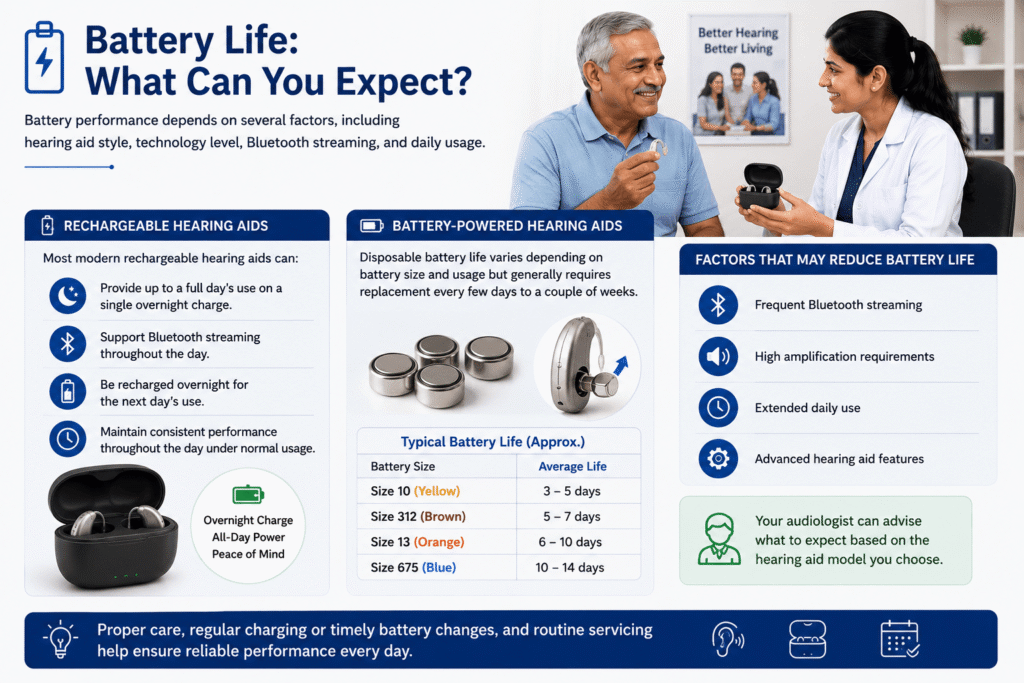
Battery Life: What Can You Expect?
Battery performance depends on several factors, including hearing aid style, technology level, Bluetooth streaming, and daily usage.
Rechargeable Hearing Aids
Most modern rechargeable hearing aids can:
- Provide up to a full day’s use on a single overnight charge.
- Support Bluetooth streaming throughout the day.
- Be recharged overnight for the next day’s use.
- Maintain consistent performance throughout the day under normal usage.
Battery-Powered Hearing Aids
Disposable battery life varies depending on battery size and usage but generally requires replacement every few days to a couple of weeks.
Factors that may reduce battery life include:
- Frequent Bluetooth streaming.
- High amplification requirements.
- Extended daily use.
- Advanced hearing aid features.
Your audiologist can advise what to expect based on the hearing aid model you choose.
Maintenance Differences
Both types of hearing aids require regular care, but daily maintenance routines differ slightly.
| Maintenance Task | Rechargeable Hearing Aids | Battery-Powered Hearing Aids |
| Daily cleaning | ✔ | ✔ |
| Moisture protection | ✔ | ✔ |
| Overnight storage | Charging dock | Dry storage case |
| Battery replacement | Not required | Required periodically |
| Charger maintenance | Occasionally clean charging contacts | Not applicable |
Regardless of the power source, proper cleaning and regular servicing help extend the life of your hearing aids.
Which Option Is Better for Different Lifestyles?
The best hearing aid isn’t the one with the newest technology—it’s the one that fits your everyday life.
| Lifestyle | Recommended Option | Why |
| Working professionals | Rechargeable | Easy overnight charging and reliable all-day performance |
| Older adults with limited hand dexterity | Rechargeable | No need to handle small disposable batteries |
| Frequent travellers | Depends on travel style | Rechargeable if charging is available; battery-powered if power access is limited |
| Outdoor enthusiasts | Battery-powered or rechargeable with portable charger | Choice depends on trip duration and charging availability |
| Occasional hearing aid users | Battery-powered | Batteries can be replaced when required without relying on regular charging |
This table highlights general considerations. Your hearing care professional can recommend the option that best matches your individual needs.
Environmental Considerations
Rechargeable hearing aids help reduce the number of disposable batteries used over time.
Potential environmental benefits include:
- Less battery waste.
- Reduced packaging.
- Fewer battery replacements.
- Lower environmental impact over the life of the hearing aids.
Battery-powered hearing aids remain a practical choice for many users, but proper disposal of used batteries is important to minimise environmental impact.
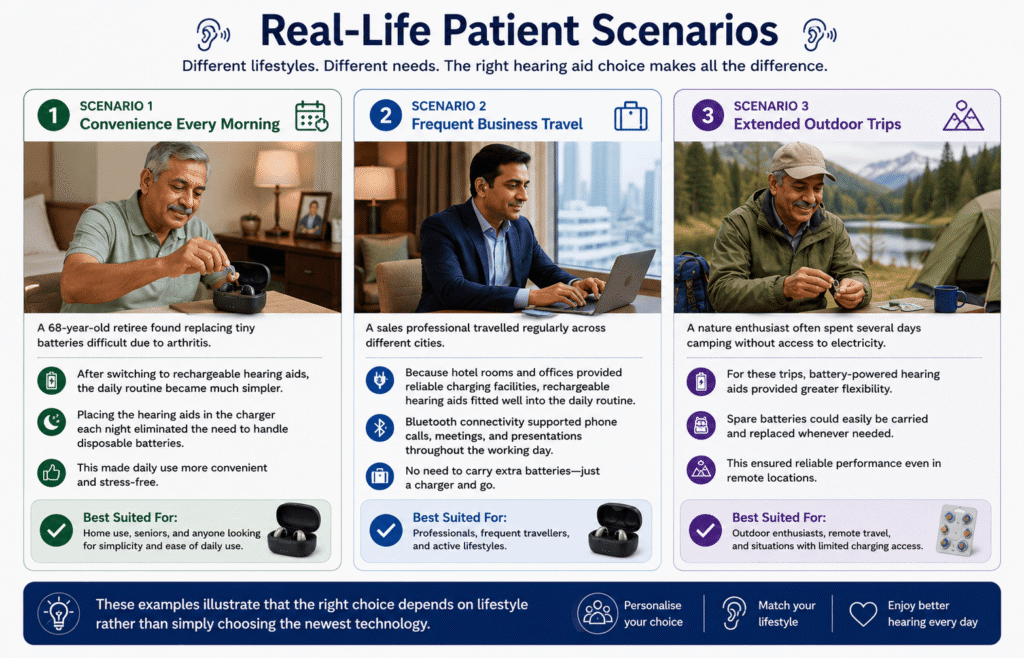
Real-Life Patient Scenarios
Scenario 1 – Convenience Every Morning
A 68-year-old retiree found replacing tiny batteries difficult due to arthritis.
After switching to rechargeable hearing aids, the daily routine became much simpler. Placing the hearing aids in the charger each night eliminated the need to handle disposable batteries and made daily use more convenient.
Scenario 2 – Frequent Business Travel
A sales professional travelled regularly across different cities.
Because hotel rooms and offices provided reliable charging facilities, rechargeable hearing aids fitted well into the daily routine, while Bluetooth connectivity supported phone calls throughout the working day.
Scenario 3 – Extended Outdoor Trips
A nature enthusiast often spent several days camping without access to electricity.
For these trips, battery-powered hearing aids provided greater flexibility because spare batteries could easily be carried and replaced whenever needed.
These examples illustrate that the right choice depends on lifestyle rather than simply choosing the newest technology.
Common Mistakes When Choosing Between Rechargeable and Battery-Powered Hearing Aids
Many first-time buyers focus on one feature while overlooking their long-term needs.
Avoid these common mistakes:
- Choosing based only on the initial purchase price.
- Ignoring your daily routine and lifestyle.
- Underestimating the importance of manual dexterity.
- Forgetting to consider travel habits.
- Assuming one option is suitable for everyone.
- Purchasing without professional guidance.
A hearing aid that fits your lifestyle is usually more satisfying than one chosen solely because it was cheaper or had more advertised features.
Expert Tips from Hearing Point
When deciding between rechargeable and battery-powered hearing aids, ask yourself:
- How comfortable am I handling small batteries?
- Do I have a regular routine that allows overnight charging?
- How often do I travel?
- Will I frequently use Bluetooth streaming?
- Which option will be easier for me over the next five years?
Discussing these questions with your hearing care professional can help you choose a solution that remains practical long after the initial purchase.
Myth vs Fact
There are many misconceptions about rechargeable and battery-powered hearing aids. Understanding the facts can help you make a more informed decision.
| Myth | Fact |
| Rechargeable hearing aids are always better than battery-powered models. | Both options have advantages. The best choice depends on your lifestyle, hearing needs, and personal preferences. |
| Rechargeable hearing aids won’t last all day. | Most modern rechargeable hearing aids are designed to provide a full day’s use on a single overnight charge under normal conditions. |
| Battery-powered hearing aids are outdated. | Many modern hearing aids still use disposable batteries and continue to provide excellent performance for many users. |
| Rechargeable hearing aids don’t require maintenance. | Although battery replacement isn’t required, regular cleaning, servicing, and proper charging remain essential. |
| Choosing the cheaper option always saves money. | Long-term costs, convenience, maintenance, and daily usability should all be considered alongside the initial purchase price. |
Rechargeable vs Battery-Powered Hearing Aids: Decision Matrix
Use this quick guide to determine which option may suit your lifestyle.
| If You… | Rechargeable | Battery-Powered |
| Want the simplest daily routine | ✅ | |
| Have arthritis or reduced finger dexterity | ✅ | |
| Frequently use Bluetooth streaming | ✅ | |
| Prefer overnight charging | ✅ | |
| Travel to places without reliable electricity | ✅ | |
| Prefer replacing batteries immediately | ✅ | |
| Already use disposable batteries comfortably | ✅ | |
| Want to reduce battery waste | ✅ |
Remember: This is a general guide. Your audiologist can recommend the most suitable option based on your hearing loss, lifestyle, and hearing aid model.
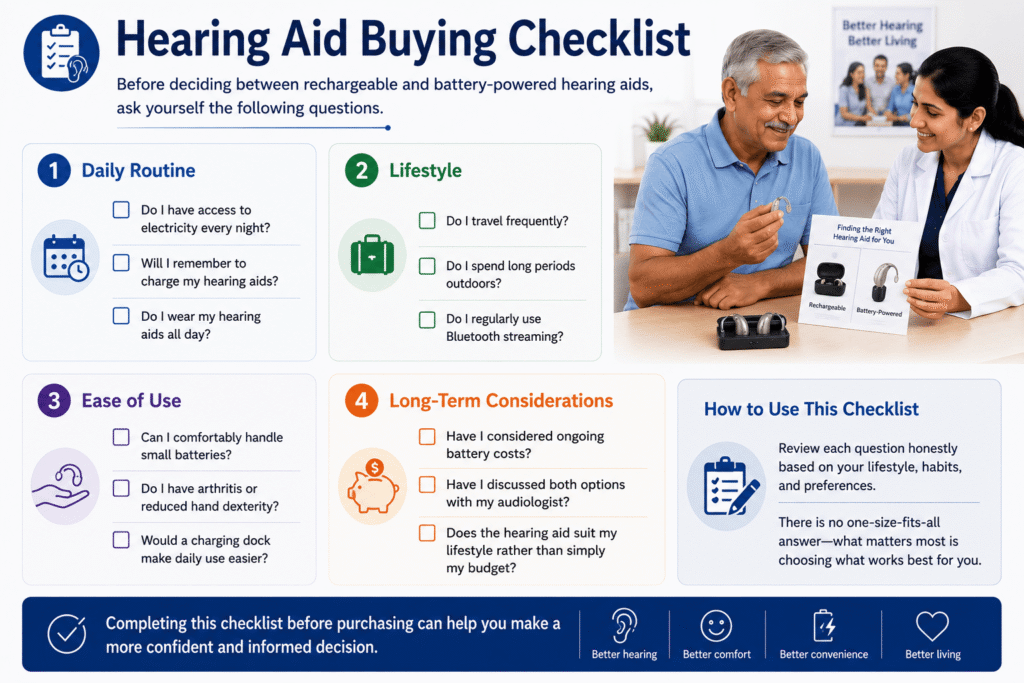
Hearing Aid Buying Checklist
Before deciding between rechargeable and battery-powered hearing aids, ask yourself the following questions.
Daily Routine
- Do I have access to electricity every night?
- Will I remember to charge my hearing aids?
- Do I wear my hearing aids all day?
Lifestyle
- Do I travel frequently?
- Do I spend long periods outdoors?
- Do I regularly use Bluetooth streaming?
Ease of Use
- Can I comfortably handle small batteries?
- Do I have arthritis or reduced hand dexterity?
- Would a charging dock make daily use easier?
Long-Term Considerations
- Have I considered ongoing battery costs?
- Have I discussed both options with my audiologist?
- Does the hearing aid suit my lifestyle rather than simply my budget?
Completing this checklist before purchasing can help you make a more confident and informed decision.
Frequently Asked Questions
Are rechargeable hearing aids worth it?
For many people, yes. Rechargeable hearing aids offer convenience, eliminate the need to replace small batteries regularly, and are particularly helpful for users who value a simple daily routine.
How long do rechargeable hearing aid batteries last?
Most modern rechargeable hearing aids are designed to provide a full day’s use on a single overnight charge. Battery lifespan varies depending on the hearing aid model, streaming usage, and listening environment.
Which is better for older adults?
Rechargeable hearing aids are often easier for older adults because they eliminate the need to handle small disposable batteries. However, the best choice depends on the individual’s needs and preferences.
Can I travel with rechargeable hearing aids?
Yes. Rechargeable hearing aids are suitable for travel, provided you have access to charging facilities. For extended trips without reliable electricity, battery-powered hearing aids or a portable charging solution may be more practical.
Do rechargeable hearing aids cost more?
Rechargeable hearing aids often have a higher initial purchase price. However, they may reduce ongoing expenses associated with buying disposable batteries over time.
Which type should I choose?
There is no single answer for everyone. Your hearing loss, lifestyle, travel habits, manual dexterity, and personal preferences all play an important role. A qualified hearing care professional can help you choose the most appropriate option.
Conclusion
Both rechargeable and battery-powered hearing aids can provide excellent hearing performance when selected and fitted appropriately.
Rechargeable hearing aids offer convenience, ease of use, and reduced maintenance for many users, while battery-powered hearing aids continue to provide flexibility and reliability in situations where replacing batteries is more practical.
Rather than focusing on one feature alone, consider how your hearing aids will fit into your everyday life. Your daily routine, travel habits, comfort, and hearing needs are all important factors when making the right decision.
If you’re unsure which option is best for you, a professional hearing assessment and personalised recommendation can help you choose a hearing aid that supports both your hearing health and your lifestyle.
Continue Your Hearing Care Journey
Continue exploring our Hearing Point Knowledge Library:
- 10 Questions to Ask Before Buying a Hearing Aid – Learn the essential questions every buyer should ask.
- Why Professional Hearing Aid Fitting Is More Important Than Price – Understand why expert fitting is just as important as the hearing aid itself.
- How Long Does It Take to Get Used to a Hearing Aid? – Learn what to expect during the first few weeks of wearing hearing aids.
- Hearing Aid Trial vs Buying Immediately: Which Is Better? (Coming Next)
About the Hearing Point Editorial Team
The Hearing Point Editorial Team creates educational resources to help individuals and families understand hearing health, hearing aids, speech therapy, balance disorders, and hearing rehabilitation.
Every article is developed using patient-focused research, current hearing care knowledge, and editorial best practices. Our goal is to provide trustworthy, easy-to-understand information that helps readers make informed decisions about their hearing health.
All educational content is reviewed for accuracy, clarity, and relevance before publication and is updated periodically to reflect developments in hearing care and hearing aid technology.
Author: Hearing Point Editorial Team
Category: Knowledge Library
Last Updated: July 2026
Educational Disclaimer
This article is intended for educational purposes only and should not replace professional hearing assessment, diagnosis, or personalised medical advice.