
Buying a Hearing Aid? Start Here.
Buying a hearing aid is a significant decision. Unlike purchasing everyday electronics, a hearing aid is a personalised medical device that becomes part of your daily life. The right choice can make conversations easier, improve confidence, and help you stay connected with the people around you. The wrong choice can lead to frustration, discomfort, and a device that spends more time in a drawer than in your ears.
If you only read one section of this guide, start with the summary below.
At a Glance
| If you… | Here’s our recommendation |
|---|---|
| Are buying your first hearing aid | Book a professional hearing assessment before comparing brands or prices. |
| Want the “best” hearing aid | Choose the hearing aid that matches your hearing loss and lifestyle—not simply the most expensive model. |
| Are comparing prices | Consider long-term value, including fitting, follow-up care, and maintenance. |
| Prefer a discreet hearing aid | Ask whether Receiver-in-Canal (RIC) or Invisible hearing aids are clinically suitable for your hearing loss. |
| Frequently struggle in noisy environments | Prioritise speech enhancement and background noise reduction rather than cosmetic features. |
| Feel overwhelmed by the options | Speak with a qualified audiologist who can recommend a personalised solution based on your hearing assessment. |
Quick Answer
If you’re buying a hearing aid, begin with a professional hearing test. Once your hearing loss has been assessed, compare hearing aid styles, essential features, fitting services, trial options, after-sales support, and warranty. The best hearing aid is the one that suits your hearing profile, daily lifestyle, and communication needs—not simply the newest or most expensive model.
What You’ll Learn
By the end of this guide, you’ll know:
- Why a professional hearing assessment should always come first.
- The questions experienced hearing aid users wish they had asked before buying.
- How to compare hearing aid styles without getting overwhelmed.
- Which hearing aid features genuinely improve daily communication.
- Why professional fitting often matters more than the hearing aid itself.
- How to avoid the most common buying mistakes.
- What to expect after purchasing a hearing aid.
Who This Guide Is For
This guide has been written for:
- Adults buying their first hearing aid.
- Family members helping parents or grandparents choose a hearing aid.
- People comparing different hearing aid styles or brands.
- Individuals who have recently been advised that they may benefit from hearing aids.
- Anyone who wants practical, trustworthy advice before investing in a hearing aid.
Whether you’ve just started researching or you’re preparing for your hearing aid consultation, this guide will help you make a more informed decision.
Why This Guide Is Different
Most articles about hearing aids focus on specifications, features, or price.
Those things are important—but they’re only part of the picture.
Choosing the right hearing aid is about understanding how you live, how you communicate, and what challenges you want to solve.
For example:
- A retired teacher who spends evenings with family may need a completely different hearing solution from a sales executive who spends most of the day in meetings.
- Two people with the same degree of hearing loss may receive different recommendations because their listening environments and daily routines are different.
- The smallest hearing aid isn’t always the most suitable. Sometimes a slightly larger device offers better comfort, easier handling, and improved performance.
This guide focuses on helping you make the right decision for your situation, rather than encouraging you to buy a particular product.
Before You Compare Hearing Aids, Read This
One of the most common mistakes people make is starting their research by comparing brands.
You might search for:
- Which hearing aid is best?
- Which brand is most reliable?
- Which hearing aid has the latest technology?
While these are reasonable questions, they are not the best place to begin.
The better question is:
“What does my hearing actually need?”
Until you understand the type and severity of your hearing loss, comparing hearing aids is like comparing prescription glasses before having an eye test.
Every hearing aid recommendation should begin with a professional hearing assessment.
That assessment provides the information needed to decide:
- Whether you need one or two hearing aids.
- Which hearing aid style is suitable.
- Which features are likely to benefit you.
- How much amplification is required.
- What you can realistically expect after fitting.
Without this information, choosing a hearing aid becomes guesswork.
Audiologist Insight
The question isn’t “Which hearing aid is the best?”
The better question is:
“Which hearing aid is best for my hearing loss, my lifestyle, and my communication needs?”
That single change in perspective often leads to a much better long-term outcome.
The Hearing Point Decision Path
Most successful hearing aid users don’t choose a device by comparing advertisements or online reviews.
They follow a simple decision process.
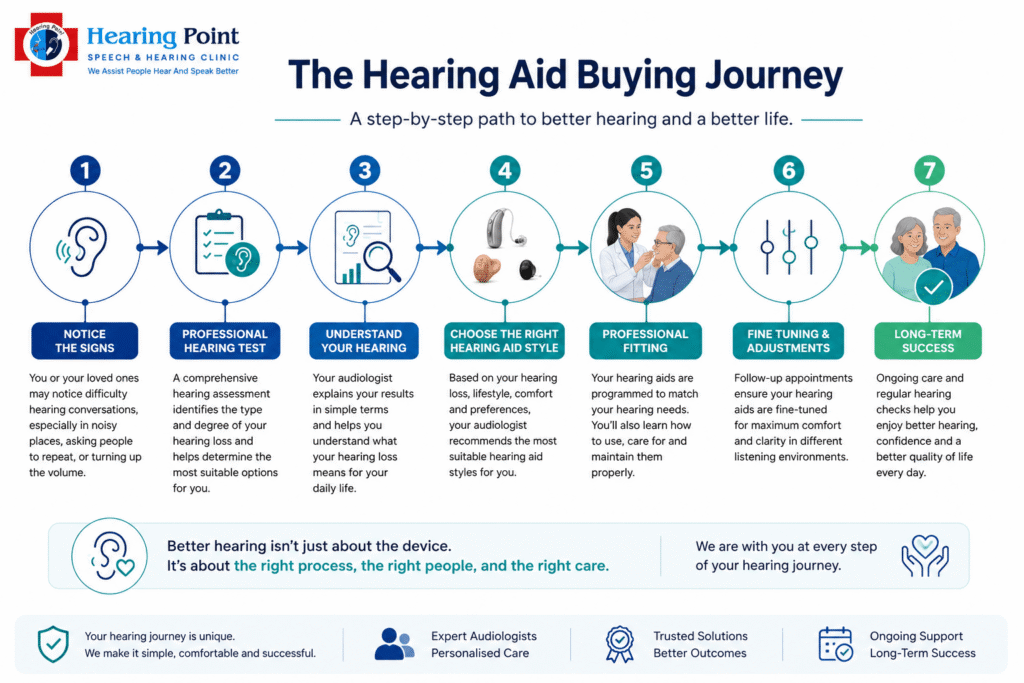
| Notice hearing difficulties │ ▼ Professional hearing assessment │ ▼ Understand your hearing loss │ ▼ Discuss your lifestyle │ ▼ Compare suitable hearing aid styles │ ▼ Professional fitting │ ▼ Fine-tuning and follow-up care │ ▼ Long-term hearing success |
Each step builds on the previous one.
Skipping any of these stages increases the chances of choosing a hearing aid that doesn’t fully meet your needs.
Before comparing hearing aid brands or features, it’s important to understand the process involved in choosing the right hearing aid. The diagram below provides a simple overview of the recommended journey, from recognising hearing difficulties to achieving long-term hearing success.
Q1. Have I Had a Professional Hearing Test?
If you remember only one piece of advice from this guide, make it this:
Never choose a hearing aid before understanding your hearing loss.
A hearing test is much more than a confirmation that you have difficulty hearing. It provides detailed information about which sounds you struggle to hear, how severe your hearing loss is, and which type of hearing aid is most likely to help.
During a comprehensive hearing assessment, an audiologist evaluates:
- The type of hearing loss.
- The degree of hearing loss.
- Speech understanding ability.
- Which sound frequencies are affected.
- Whether one or both ears require amplification.
This information allows recommendations to be based on clinical findings rather than assumptions.
Real-Life Example
A 66-year-old gentleman visited a hearing clinic after his family complained that he constantly increased the television volume.
He had already decided that he wanted the smallest invisible hearing aid available because he didn’t want anyone to notice it.
However, after his hearing assessment, it became clear that a Receiver-in-Canal (RIC) hearing aid would provide better speech understanding and be easier to adjust for his hearing profile.
Initially, he was disappointed because the device was slightly more visible than he had imagined.
Three months later, his opinion had completely changed.
The improvement in conversations with his grandchildren mattered far more than whether anyone noticed the hearing aid.
Lesson: The best hearing aid is the one that helps you hear better—not necessarily the one that is least visible.
Why This Matters
Many first-time buyers assume that everyone with hearing loss needs the same type of hearing aid.
In reality, two people of the same age with similar symptoms may require completely different solutions.
One person may struggle mainly with high-frequency sounds, while another has hearing loss across multiple frequencies.
Their hearing aids may look similar, but the programming, amplification, and recommended features can be completely different.
That is why a professional hearing assessment is the foundation of every successful hearing aid fitting.
Q2. Which Hearing Aid Style Is Right for My Lifestyle?
Not every hearing aid style is suitable for every type of hearing loss. The diagram below provides a simple overview of the hearing aid styles commonly recommended for mild, moderate, and severe hearing loss. Your audiologist will recommend the most appropriate option after evaluating your hearing test results, lifestyle, and communication needs.
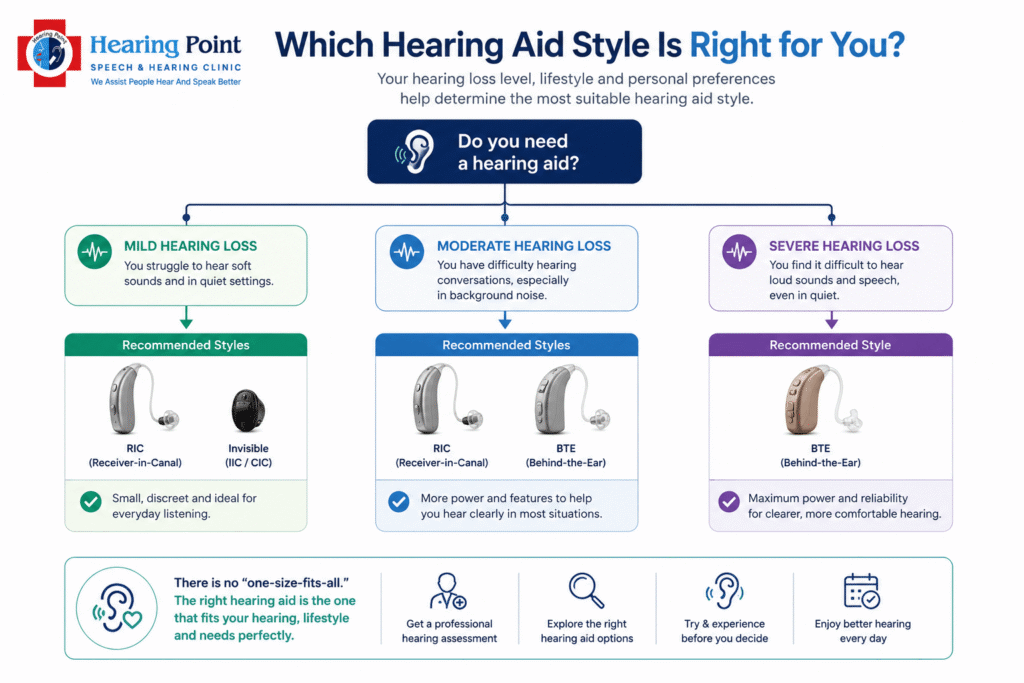
Once you’ve completed a professional hearing assessment, the next step is choosing a hearing aid style that suits the way you live.
This is where many people become overwhelmed.
A quick online search introduces terms like BTE, RIC, ITE, ITC, and Invisible Hearing Aids. While each style has its own advantages, there isn’t a single option that’s best for everyone.
The right hearing aid should fit comfortably into your daily routine. Think about where you spend most of your time, the conversations you have every day, and how you prefer to use technology.
For example:
- If you regularly attend business meetings, speech clarity in noisy environments may be your highest priority.
- If you’re retired and spend most of your time at home, ease of use and comfort may matter more than advanced connectivity.
- If discretion is important, a smaller hearing aid may be appropriate—but only if it matches your hearing profile.
Instead of asking:
“Which hearing aid style is the most popular?”
Ask:
“Which hearing aid style will make my everyday life easier?”
That simple change often leads to a better decision.
Hearing Aid Style Comparison
| Hearing Aid Style | Best Suited For | Advantages | Things to Consider |
|---|---|---|---|
| Behind-the-Ear (BTE) | Mild to profound hearing loss | Powerful, easy to handle, suitable for many users | Slightly more visible than smaller styles |
| Receiver-in-Canal (RIC) | Mild to severe hearing loss | Natural sound quality, comfortable, discreet | Requires regular maintenance of the receiver |
| In-the-Ear (ITE) | Mild to severe hearing loss | Custom-made, easy insertion | Larger than invisible models |
| Invisible (IIC/CIC) | Mild to moderate hearing loss | Highly discreet | Not suitable for every hearing loss or ear shape |
One important point to remember is that visibility should never be the only deciding factor.
Many first-time buyers are drawn to the smallest device available. However, a slightly larger hearing aid may offer better comfort, longer battery life, easier handling, and improved speech understanding.
Audiologist Insight
A hearing aid should fit your lifestyle just as well as it fits your ears.
Someone who frequently travels, attends social gatherings, or spends time in busy environments will have different listening needs from someone who enjoys a quieter daily routine.
The goal isn’t simply to make sounds louder—it’s to help you communicate comfortably in the situations that matter most.
Real-Life Example
A 45-year-old project manager initially requested an invisible hearing aid because he believed it would look more professional.
After discussing his work routine, he explained that he spent several hours each day on video calls and often moved between quiet offices and busy construction sites.
His audiologist recommended a Receiver-in-Canal (RIC) hearing aid with automatic environmental adjustments and Bluetooth connectivity.
Although it wasn’t completely invisible, it delivered clearer speech during meetings and allowed him to take phone calls directly through his hearing aids.
A few months later, he commented that no one had noticed his hearing aids—but everyone had noticed that he was participating more confidently in conversations.
Lifestyle Decision Matrix
Now that you understand which hearing aid style may suit different levels of hearing loss, it’s helpful to compare them side by side. The comparison below summarises the key differences between Behind-the-Ear (BTE), Receiver-in-Canal (RIC), In-the-Ear (ITE), and Invisible (IIC/CIC) hearing aids to help you understand their strengths and practical considerations.
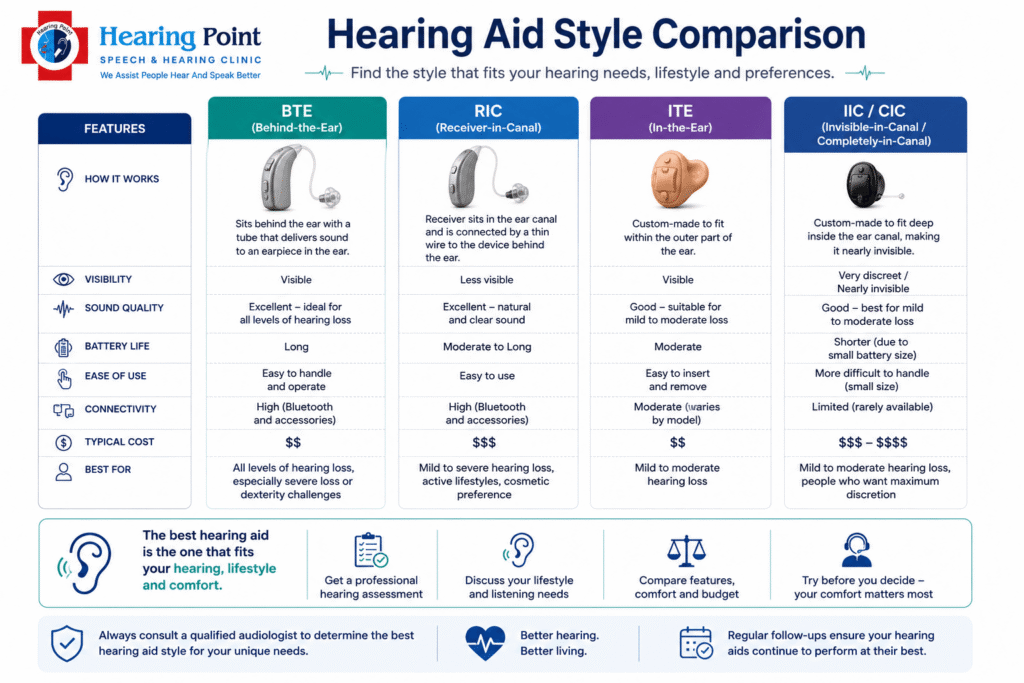
Choosing a hearing aid becomes much easier when you start with your daily routine rather than the device itself.
| Your Lifestyle | What to Prioritise |
|---|---|
| Mostly at home | Comfort, easy controls, reliable speech clarity |
| Working professional | Noise reduction, Bluetooth, automatic programmes |
| Active social life | Strong speech understanding in background noise |
| Regular traveller | Rechargeable batteries, durability, convenience |
| Limited hand dexterity | Larger controls, easier cleaning and maintenance |
| Cosmetic preference | Smaller styles, provided they are clinically suitable |
This table is intended as a general guide. Your hearing assessment should always determine the final recommendation.
Q3. Which Hearing Aid Features Will Actually Improve My Daily Life?
The infographic below explains some of the most important hearing aid features and how they can benefit different lifestyles and communication needs.
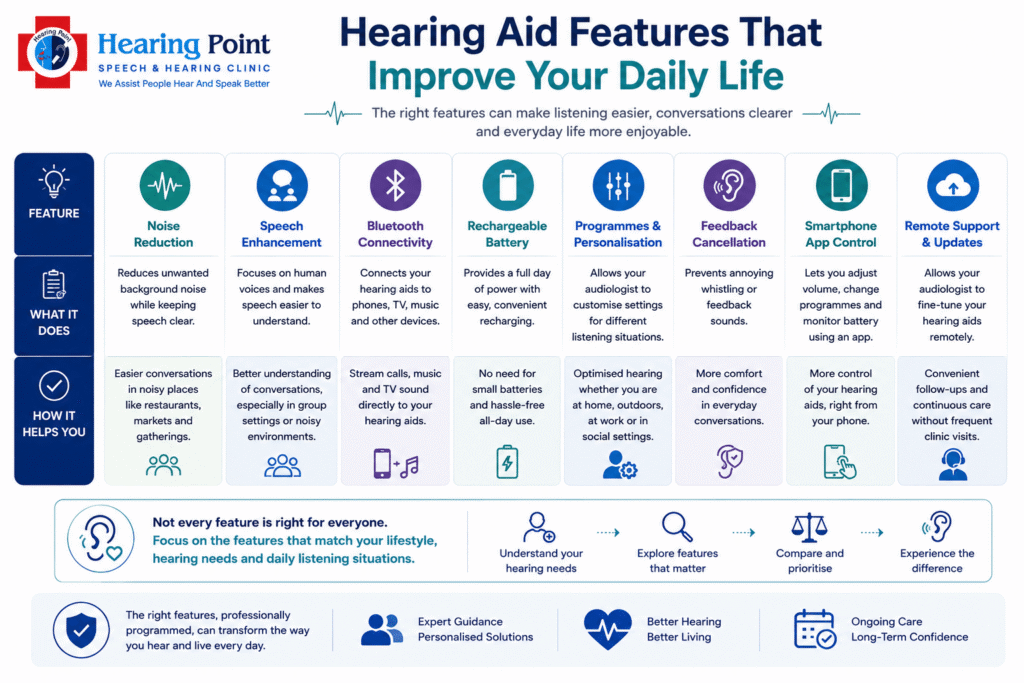
Modern hearing aids include an impressive range of technology.
Some automatically recognise different listening environments.
Others connect directly to smartphones, televisions, or tablets.
Many first-time buyers assume they should choose the hearing aid with the longest list of features.
In reality, the best technology is the technology you’ll actually benefit from.
A feature that transforms one person’s listening experience may be unnecessary for someone else.
Instead of asking:
“Which hearing aid has the most features?”
Ask:
“Which features will solve the listening problems I experience every day?”
Features That Matter Most
| Feature | Why It Helps | Ideal For |
|---|---|---|
| Noise Reduction | Makes speech easier to understand in busy places | Restaurants, markets, family gatherings |
| Directional Microphones | Focuses on voices in front of you | Meetings and conversations |
| Bluetooth Connectivity | Streams calls and audio directly | Smartphone users |
| Rechargeable Batteries | Removes the need to replace batteries regularly | Seniors and everyday users |
| Feedback Management | Reduces whistling sounds | First-time hearing aid users |
| Automatic Programmes | Adjusts settings as environments change | Active lifestyles |
The key is choosing features that support the way you live—not paying for technology you’ll rarely use.
Common Buying Mistake
Many people compare hearing aids the same way they compare mobile phones.
They assume that more features automatically mean a better product.
Hearing aids are different.
The best hearing aid is the one that improves communication in your everyday life.
If you rarely use a smartphone, Bluetooth streaming may not be your highest priority.
If you spend most of your time talking with family in busy environments, speech enhancement and background noise reduction are likely to make a much bigger difference.
Q4. Should I Ask for a Hearing Aid Trial?
The infographic below highlights the key points to discuss during your consultation.
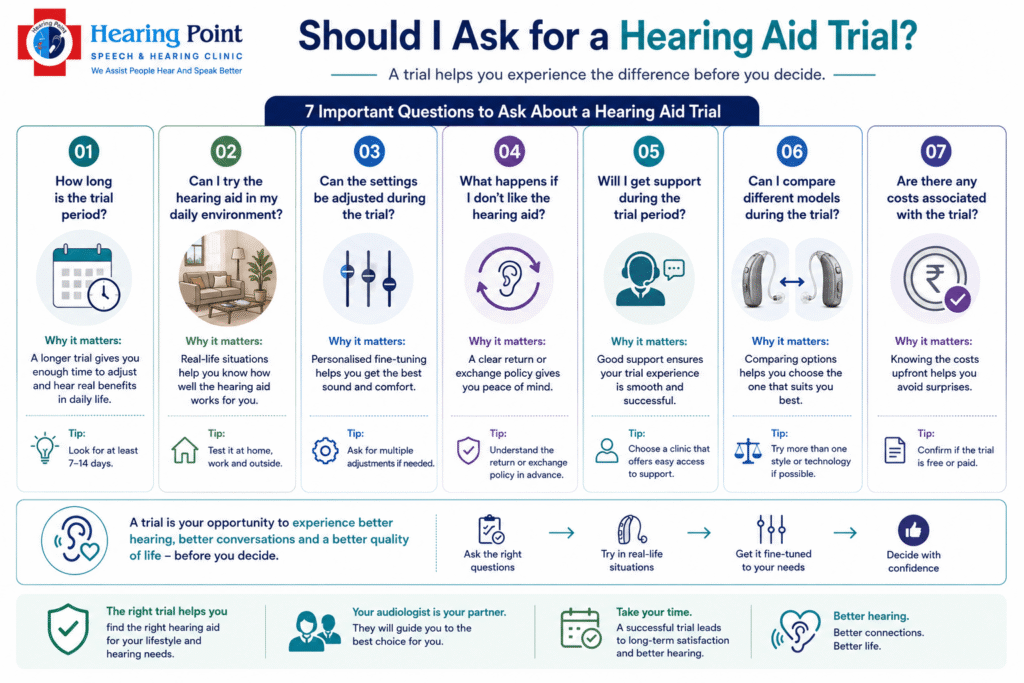
Yes—whenever possible.
A hearing aid demonstration inside a clinic provides only a small glimpse of what daily use will feel like.
Real life is different.
You’ll wear your hearing aids:
- During conversations at home.
- While watching television.
- In restaurants and cafés.
- During phone calls.
- While shopping.
- At family gatherings.
A trial period gives you the opportunity to experience how the hearing aids perform in these everyday situations.
It also allows your audiologist to make adjustments based on your real-world experiences rather than assumptions.
What You Should Ask About a Trial
Before starting a trial, ask:
- How long does the trial last?
- Can the hearing aids be adjusted during the trial?
- What happens if a different style is more suitable?
- Will follow-up appointments be included?
- What should I expect during the first few weeks?
The more you understand the process, the more confident you’ll feel in your decision.
Real-Life Example
A retired couple visited a hearing clinic together.
The husband believed he was hearing well enough and only agreed to try hearing aids because his wife insisted.
During the first week of the trial, he realised how many everyday sounds he had gradually stopped noticing, including birds singing in the morning and quieter conversations during family meals.
After a few adjustment appointments, he commented that he no longer felt as tired after social gatherings because he wasn’t constantly trying to guess what people were saying.
The hearing aids hadn’t simply made sounds louder—they had reduced the effort required to listen.
Q5. Who Will Fit and Program My Hearing Aid?
Choosing the right hearing aid is only part of the journey. Professional assessment, accurate programming, and ongoing follow-up appointments all play a vital role in helping you hear comfortably in everyday life. The infographic below explains what you should expect from a qualified hearing care professional throughout your hearing care journey.
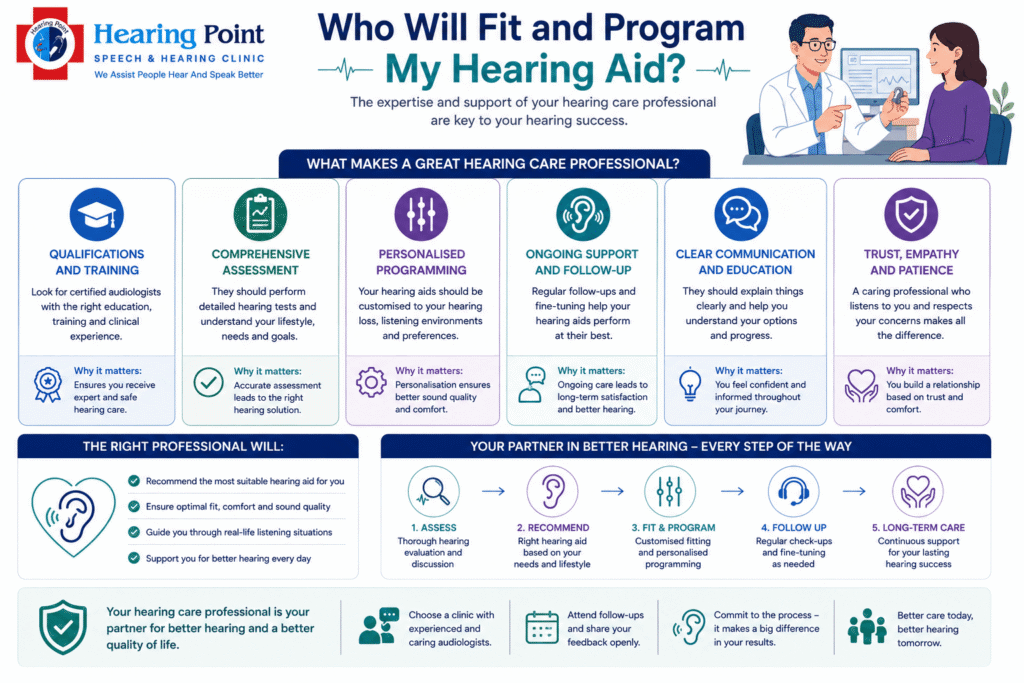
This question is often overlooked, but it can have a greater impact on your success than the hearing aid itself.
A hearing aid is not ready to wear straight out of the box.
It needs to be programmed according to your hearing assessment and fine-tuned to suit your comfort and listening preferences.
Professional fitting includes:
- Programming the hearing aid using your hearing test results.
- Adjusting speech clarity and overall amplification.
- Reducing unwanted feedback.
- Ensuring a comfortable physical fit.
- Making changes as your hearing or listening needs evolve.
Without proper fitting, even the most advanced hearing aid may fail to deliver the results you expect.
The Hearing Aid Success Formula
Long-term success usually comes from combining several factors rather than relying on technology alone.
| Professional Hearing Assessment ⬇ Correct Hearing Aid Style ⬇ Personalised Programming ⬇ Consistent Daily Use ⬇ Regular Follow-Up Appointments ⬇ Better Communication and Long-Term Satisfaction |
Each stage supports the next.
Skipping follow-up appointments or delaying adjustments often prevents users from getting the full benefit of their hearing aids.
Expert Advice
One of the biggest misconceptions about hearing aids is that buying the device is the final step.
In reality, it’s the beginning of the rehabilitation process.
The first few weeks are often the most important because your brain is relearning sounds it may not have heard clearly for months or even years.
Regular follow-up appointments allow your audiologist to fine-tune the hearing aids as you adapt, helping you achieve better comfort and clearer speech over time.
Q6. What After-Sales Support Should I Expect?
Buying a hearing aid is not the end of the process—it is the beginning of your hearing rehabilitation journey. The infographic below highlights the key after-sales services that help hearing aid users get the most from their devices over time.
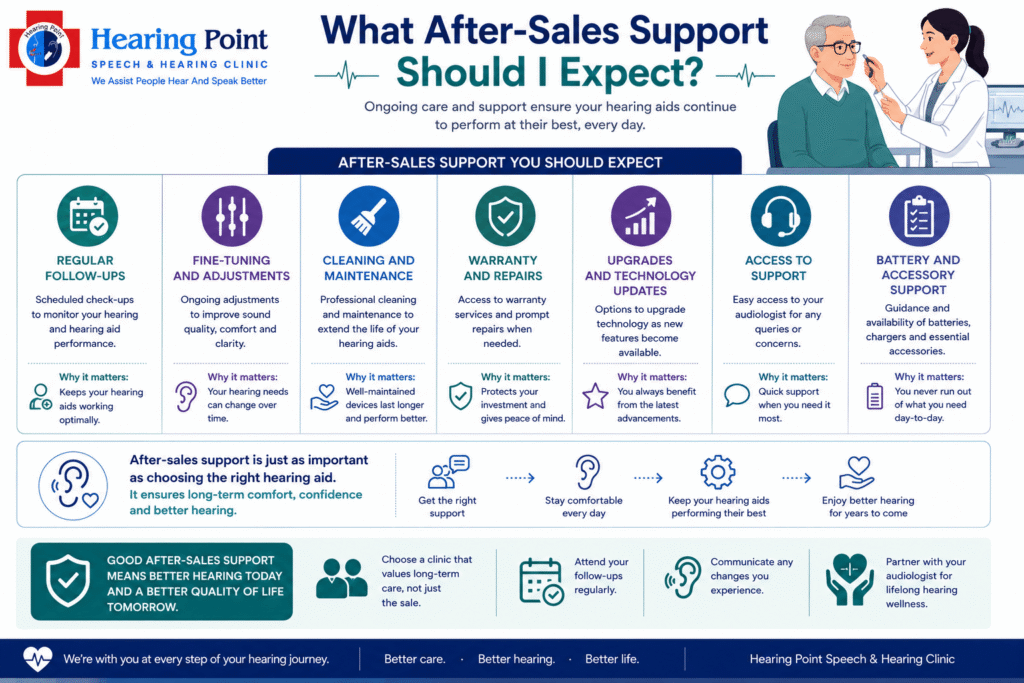
Many first-time buyers assume that once the hearing aid is fitted, there is nothing more to do. In reality, the first few weeks are when the most important adjustments happen.
Your brain needs time to adapt to hearing sounds that may have been missing for months or even years. During this adjustment period, your audiologist may fine-tune the hearing aid based on your feedback.
Ask your hearing care provider:
- How many follow-up appointments are included?
- Will my hearing aid be reprogrammed if needed?
- Are cleaning and maintenance services available?
- How often should I return for routine checks?
- What happens if I experience discomfort or poor sound quality?
A provider that offers comprehensive after-sales care is supporting your long-term hearing success—not just the initial purchase.
Why Follow-Up Appointments Matter
It is common for first-time hearing aid users to need several adjustments.
For example:
- Background sounds may initially seem louder than expected.
- Certain voices may require fine-tuning.
- The physical fit may need small adjustments for better comfort.
These issues are normal and can often be resolved during follow-up visits.
Patients who attend their review appointments generally experience better long-term satisfaction than those who stop wearing their hearing aids after the first week.
Q7. What Warranty Is Included?
A hearing aid is an investment in your hearing health, so understanding the warranty is important.
Before making your decision, ask:
- What does the warranty cover?
- How long is the warranty valid?
- Are manufacturing defects included?
- Is accidental damage covered?
- What happens if repairs are needed after the warranty expires?
While warranty terms vary between manufacturers and providers, understanding them before purchasing helps you make a more informed decision.
Expert Tip
Don’t compare warranties by duration alone.
Also consider:
- Access to local service centres.
- Turnaround time for repairs.
- Availability of replacement devices if servicing is required.
- Ongoing technical support.
Reliable service can be just as valuable as the hearing aid itself.
Q8. Can My Hearing Aid Be Adjusted If My Hearing Changes?
Yes.
Modern digital hearing aids are designed to be reprogrammed as your hearing needs evolve.
Hearing changes gradually for many people. Instead of replacing the entire hearing aid, your audiologist can often adjust the programming to better match your updated hearing test results.
This is why regular hearing reviews remain important, even after you’ve become comfortable with your hearing aids.
Ask your audiologist:
- How often should my hearing be reassessed?
- Can this hearing aid be adjusted in the future?
- Will future programming appointments be included?
Choosing a hearing aid that can adapt over time provides greater long-term value.
Q9. What Is the Total Cost of Ownership?
The purchase price is only one part of the investment.
When comparing hearing aids, consider the complete ownership experience.
This may include:
- Professional fitting.
- Follow-up appointments.
- Routine servicing.
- Cleaning supplies.
- Replacement domes or wax guards.
- Charging accessories, where applicable.
- Future programming sessions.
Sometimes, a hearing aid with a higher initial price offers better long-term value because ongoing support is included.
Instead of asking:
“Which hearing aid costs less?”
Ask:
“Which option offers the best overall value for my hearing care?”
Q10. Why Is This Hearing Aid Recommended for Me?
This is perhaps the most important question you can ask before making your final decision.
A good recommendation should never sound like:
“This is our best-selling hearing aid.”
Instead, your audiologist should explain:
- Why this hearing aid matches your hearing loss.
- Why it suits your lifestyle.
- Which features are likely to benefit you.
- What limitations you should be aware of.
- What improvements you can realistically expect.
When you understand the reason behind the recommendation, you can make your decision with confidence rather than uncertainty.
The Hearing Point Buyer’s Confidence Framework™
After helping hundreds of people choose hearing aids, one principle remains consistent:
Successful hearing aid users follow a process—not just a purchase.
Step 1 – Understand Your Hearing
Complete a professional hearing assessment before comparing hearing aid brands or features.
Step 2 – Understand Your Lifestyle
Think about where you spend your time.
- At home.
- At work.
- In meetings.
- With family.
- In social settings.
Your hearing aid should support these everyday situations.
Step 3 – Compare Suitable Styles
Choose a hearing aid based on:
- Your hearing loss.
- Comfort.
- Ease of handling.
- Daily routine.
Appearance should be considered—but never at the expense of performance.
Step 4 – Choose Features That Matter
Prioritise features that solve your communication challenges rather than choosing technology simply because it is available.
Step 5 – Invest in Professional Fitting
Programming, fine-tuning, and follow-up care often have a greater influence on long-term satisfaction than the hearing aid model itself.
Step 6 – Commit to Ongoing Care
Schedule regular hearing reviews and attend follow-up appointments to ensure your hearing aids continue to perform at their best.
Printable Consultation Checklist
Take this checklist with you to your hearing aid appointment.
Before Buying
- Have I completed a professional hearing assessment?
- Do I understand my hearing loss?
- Have I compared different hearing aid styles?
- Why is this hearing aid being recommended?
- Are there alternative options?
- Can I try the hearing aid before making a final decision?
During the Consultation
- What features will benefit me most?
- How many follow-up appointments are included?
- Can the hearing aid be adjusted later?
- What maintenance is required?
- What warranty is included?
- Who should I contact if I experience problems?
After Purchase
- When should I return for my first review?
- How should I clean and care for my hearing aid?
- How often should my hearing be reassessed?
Common Buying Mistakes
Avoid these common mistakes before purchasing a hearing aid.
❌ Choosing a hearing aid based only on price.
❌ Comparing brands before understanding your hearing loss.
❌ Assuming the smallest hearing aid is always the best.
❌ Skipping follow-up appointments.
❌ Ignoring after-sales support.
❌ Expecting immediate perfection without an adjustment period.
Myth vs Fact
| Myth | Fact |
|---|---|
| The most expensive hearing aid is always the best. | The best hearing aid is the one that matches your hearing profile and lifestyle. |
| Hearing aids restore normal hearing immediately. | Most users need time to adapt, and fine-tuning is part of the process. |
| Invisible hearing aids are suitable for everyone. | Suitability depends on your hearing loss and ear anatomy. |
| Once fitted, hearing aids never need adjustment. | Regular programming helps maintain performance as your hearing changes. |
| Buying online always saves money. | Long-term value often depends on professional fitting and ongoing support. |
Frequently Asked Questions
What is the first step before buying a hearing aid?
The first step is a professional hearing assessment. This identifies the type and degree of hearing loss and helps determine which hearing aid styles and features are most appropriate.
How long does it take to get used to a hearing aid?
Most people adapt within two to six weeks. Consistent daily use and follow-up appointments help the adjustment process.
Can hearing aids be reprogrammed?
Yes. Modern digital hearing aids can usually be adjusted as your hearing changes or your listening needs evolve.
Should I buy a hearing aid online or from a clinic?
While online options may appear convenient, professional assessment, fitting, programming, and ongoing support are important parts of successful hearing rehabilitation.
How often should hearing aids be serviced?
Regular maintenance and periodic professional reviews help keep hearing aids performing effectively. Your audiologist can recommend an appropriate schedule based on your device and hearing needs.
Is it normal for hearing aids to sound unusual at first?
Yes. Many first-time users notice that everyday sounds seem different during the first few weeks. Your brain gradually adapts, and follow-up adjustments can improve comfort and sound quality.
Continue Your Hearing Journey
If this guide has helped you understand the buying process, these resources may also be useful:
Start Here
- Hearing Aids: Complete Overview
- Types of Hearing Aids Explained
- What Happens During a Hearing Test?
Compare Your Options
Planning Your Purchase
Final Thoughts
Choosing a hearing aid is about much more than selecting a device.
It is about choosing a solution that helps you communicate more comfortably, participate confidently in everyday conversations, and stay connected with the people who matter most.
Take your time.
Ask questions.
Understand your hearing.
Choose a hearing aid based on professional advice rather than assumptions.
Remember that successful hearing care is a partnership between you and your audiologist. The hearing aid is only one part of the journey—the guidance, fitting, and ongoing support you receive are equally important.
By following the recommendations in this guide, you will be in a much stronger position to choose a hearing aid that supports your hearing health for years to come.
About This Guide
This article has been prepared as an educational resource to help individuals understand the key factors involved in buying a hearing aid.
It does not replace a professional hearing assessment or personalised medical advice. Every person’s hearing needs are different, and the most appropriate hearing solution should always be based on a comprehensive evaluation by a qualified hearing care professional.
About Hearing Point Editorial Team
The Hearing Point Editorial Team creates educational content to help individuals and families better understand hearing loss, hearing aids, speech therapy, and hearing healthcare.
Our articles are developed using guidance from qualified hearing care professionals, reputable clinical resources, and current industry best practices. Every article is reviewed regularly to ensure the information remains accurate, relevant, and easy to understand.
Educational Disclaimer
This article is intended for educational purposes only and should not replace professional hearing assessment, diagnosis, or personalised medical advice.